
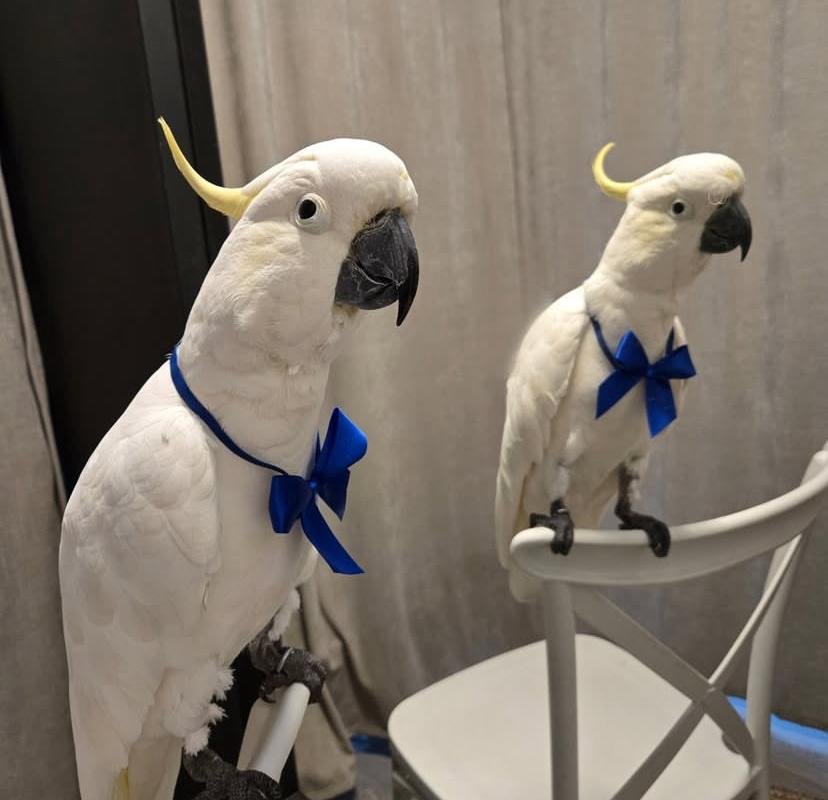
Description
Cockatoos in Missouri
Cockatoos in Missouri can be an appealing search for someone interested in unusual parrots, but Carnaby’s black cockatoo is not an ordinary companion-bird species. Dexter, the male Carnaby’s black cockatoo described here, belongs to Zanda latirostris, a species native to southwestern Western Australia and officially classified as endangered.
For anyone considering a Carnaby’s cockatoo, the first question should be whether the bird was legally captive-bred and whether all required wildlife documentation and permits are in place. A responsible keeper should never purchase a bird simply because it is advertised as rare or difficult to find.
Carnaby’s black cockatoos are large birds, reaching roughly 53–58 cm in length and weighing up to about 790 g. Their striking black plumage, white tail panels and distinctive cheek markings make them immediately recognizable. Males have a black bill and pinkish eye-ring, while females have a paler bill and grey eye-ring.
They are also highly social birds. In the wild, Carnaby’s cockatoos may travel in pairs or large feeding groups, moving seasonally in response to food availability. Their natural diet includes seeds from plants such as Banksia, Hakea, marri and jarrah, along with flowers, nectar and some insect larvae.
That natural history matters when considering Cockatoos in Missouri. A large black cockatoo needs considerably more than a small household cage and a bowl of seed. Proper housing, substantial daily enrichment, a suitable diet, opportunities for chewing and exercise, and access to an avian veterinarian all need to be considered before bringing such a bird into a home.
Carnaby’s cockatoos can also live for decades. The Western Australian Museum gives a lifespan of approximately 25–50 years, meaning ownership is a serious long-term commitment rather than a short-term pet decision.
Most importantly, Carnaby’s is an endangered species. Habitat loss, fragmentation, declining food resources and the loss of old trees containing suitable nesting hollows have contributed to its decline in the wild.
For that reason, any legitimate transaction involving this species should be approached with particular attention to lawful captive-breeding history, provenance and applicable wildlife regulations rather than treating the bird like an ordinary parrot purchase.









Oberyn Martell –
My Sulphur-crested cockatoo is gorgeous and full of personality. The delivery was right on time, and the packaging was secure. Great customer service and very healthy birds.